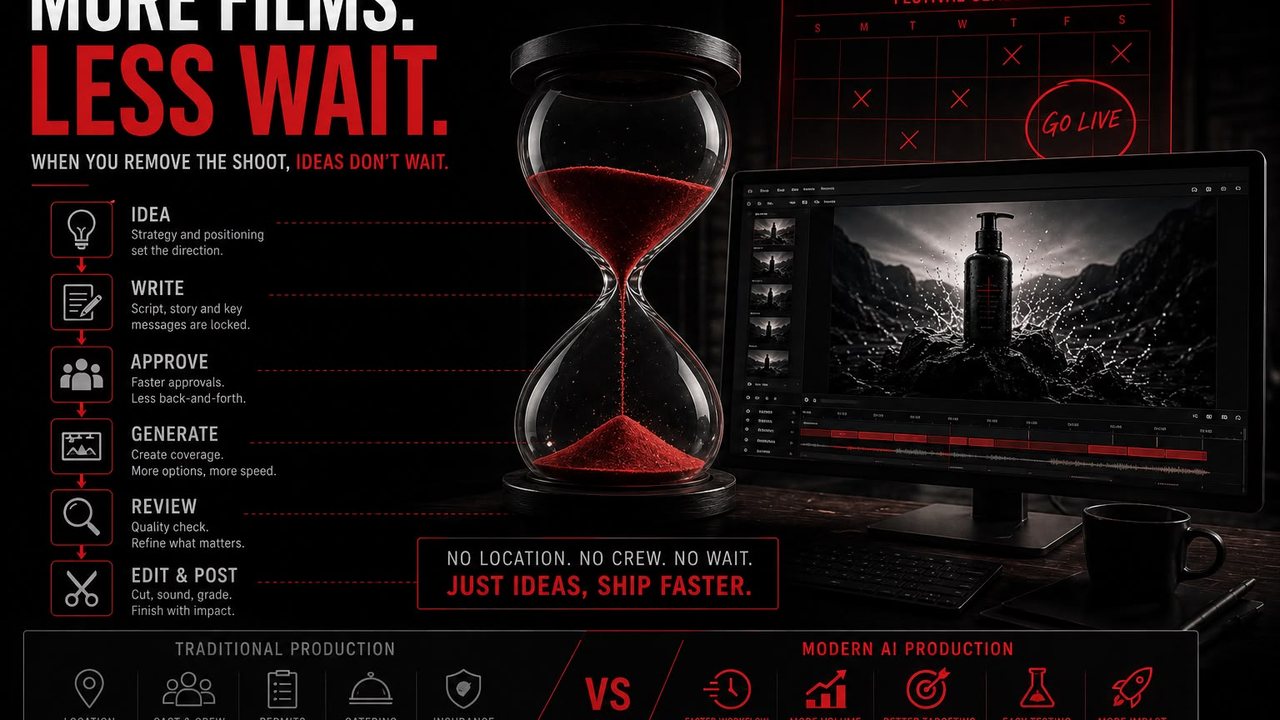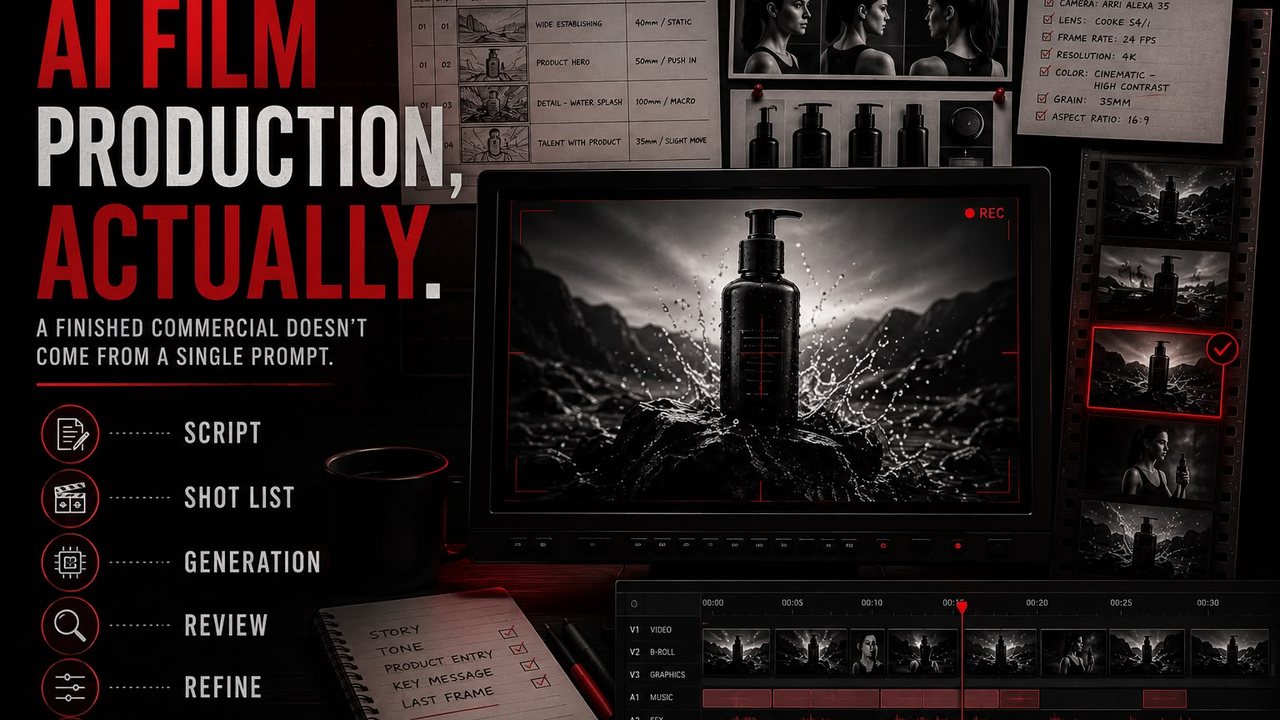
The most common misunderstanding about AI film production is that a finished commercial comes out of a single prompt. It does not. A 30-second film is usually somewhere between twelve and twenty distinct shots, each generated, reviewed, and often re-run several times before it earns its place in the cut. The work that makes it look like a film happens before and after that.
It starts as a script
Every project begins the way it always did: with a product truth and a single feeling the film has to leave behind. Before anything is generated we write a treatment — the story spine, the tone, the way the product enters, the last frame. That document gets approved. Skipping it is how studios end up with beautiful shots that do not add up to an ad.
The shot list is the film
Next comes the shot list, and it is far more specific than a prompt. Each shot carries a framing, a lens, a camera move, a light direction, the action, and continuity notes tying it to the shots either side of it. A wide establishing shot on a 40mm at golden hour is a different instruction from “a nice shot of the street.” The first one can be judged; the second cannot.
We also fix the visual register at this stage — the camera body and lens character being emulated, the grade, the grain, the frame rate. Those stay identical for every shot in the film. This single decision does more for coherence than anything else in the pipeline.
Generation is coverage, not magic
Production means generating each shot, watching it, and deciding whether it matches the board. Some land on the first pass. Others take five. The judgement being applied is the same one a director applies on set: is the eyeline right, does the move motivate the cut, does the product read.
We generate more coverage than we need for exactly the reason a crew does — the edit always wants an option that was not in the plan.
Consistency is the whole job
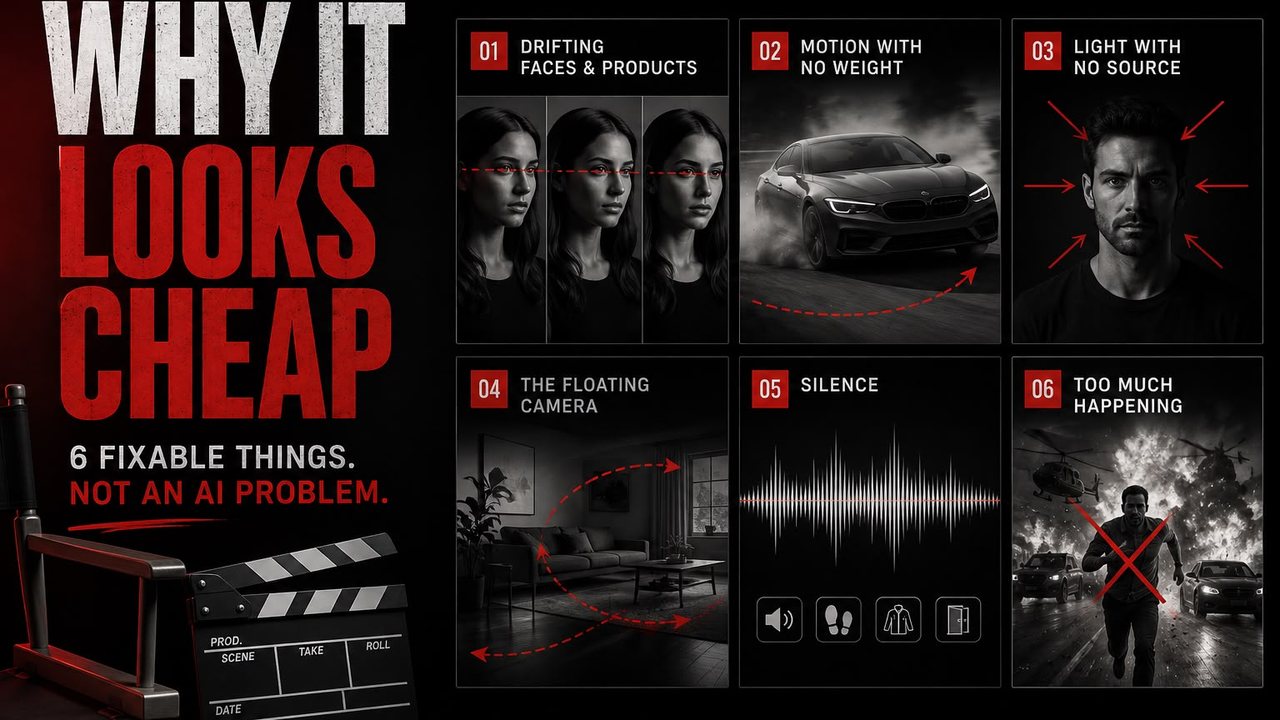
The hardest problem in this medium is sameness. A face that shifts between shots, a bottle whose label redraws itself, a room that changes layout when the camera turns around — these are what make a film feel generated rather than directed.
The fix is boring and mechanical: character sheets before production, first-frame anchoring between linked shots, product references held in every prompt, and a review pass whose only job is to catch drift. On a well-run film, nothing in the frame changes unless the script says it changes.
Post is still post
Once the shots exist, the work is ordinary filmmaking. Assembly, timing, the grade that unifies everything, sound design, voice, music, subtitles. Sound in particular carries far more of the believability than people expect — a shot that felt synthetic silent often stops feeling that way once the room tone, the footsteps and the score are under it.
What the schedule really looks like
For a 30-second film: a day or two on script, a day on boards, three to six days of production, two to four days of post, and whatever approvals need. One to three weeks, end to end, with the variance coming almost entirely from how many rounds of feedback the client wants.
What has actually changed is not the craft. It is that the expensive, un-reversible parts of production — the location, the crew, the shoot day — are no longer the thing you are betting on. You can change your mind on day four.